
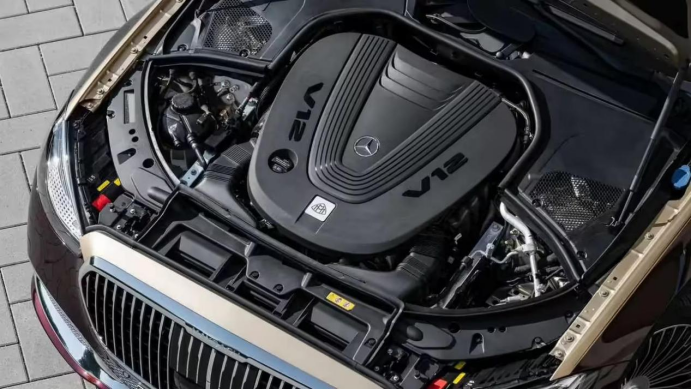
On March 26, 2026, it was reported that Mercedes-Benz will completely cease production of V12 engines in the EU market. This twin-turbocharged 6.0-liter engine is being phased out due to stricter emission regulations.
It is noted that the discontinuation of the V12 engine is not limited to the EU alone; all countries and regions that adopt the EU Vehicle Type Approval Certificate (CoC) standards will stop supplying this largest displacement internal combustion engine from Mercedes. This includes non-EU countries such as Iceland, Liechtenstein, and Norway, as well as regions like India, which will also bid farewell to this engine simultaneously.
A Mercedes-Benz spokesperson stated in a statement to Motor1: “Our clear goal is to ensure that all Mercedes-Benz and Mercedes-Maybach models meet the highest demands of our customers. We continuously iterate our models and engines and regularly adjust our product lineup for specific markets, while strictly complying with all current regulations, including Euro 7.”
To fill the flagship power gap left by the withdrawal of the V12 engine, Mercedes-Benz has clearly stated that in Europe, markets where the EU conformity certificate applies, and some regions such as India, the upgraded V8 engine will become the new flagship powertrain. This V8 engine has a maximum power output of up to 450 kW (603 horsepower), matching the power output of the current V12 engine. Mercedes-Benz firmly believes that its driving comfort and power performance can fully meet the high-end brand positioning of Maybach.
It is worth noting that the V12 engine has not been completely discontinued and will continue to be supplied in Maybach’s core markets, including China, the United States, and the Middle East. At the same time, the classic S680 name will continue to be used globally—even though some regions will switch to the V8 engine, core markets such as China and the United States will retain the V12 powertrain version. The core reason for this decision is that the upgraded V8 version can achieve power output comparable to the V12 version.
Among them, the Maybach S680 sold in the U.S. market still has a unique advantage: its V12 engine can output 621 horsepower, 18 horsepower more than the V8 version; torque reaches 900 Nm, 50 Nm more than the V8 engine, continuing to provide local consumers with a top-level power experience.
The withdrawal of the Mercedes-Benz V12 also reflects the survival difficulties of large-displacement internal combustion engines under stringent emission regulations. Currently, the Bentley Flying Spur equipped with the W12 engine has officially been discontinued, and the twelve-cylinder versions of the Volkswagen Phaeton and Audi A8 have long since exited the stage of history; BMW also eliminated the V12 engine after the previous generation 7 Series was discontinued, retaining it only in Rolls-Royce Ghost and Phantom models.Industry insiders analyze that large-displacement engines inherently face greater emission pressures, and under the increasingly strict environmental regulations, their elimination has become an inevitable trend unless automakers invest heavily in equipping them with electrification systems. However, the Maybach S-Class itself is a niche flagship model, and investing huge costs to develop a complex V12 hybrid powertrain does not make practical sense from a market return perspective, which is also one of the important reasons why Mercedes-Benz abandoned this engine.